Reuse, and who will drink it
Treated wastewater can be made cleaner than most sources; the obstacle has rarely been the engineering.
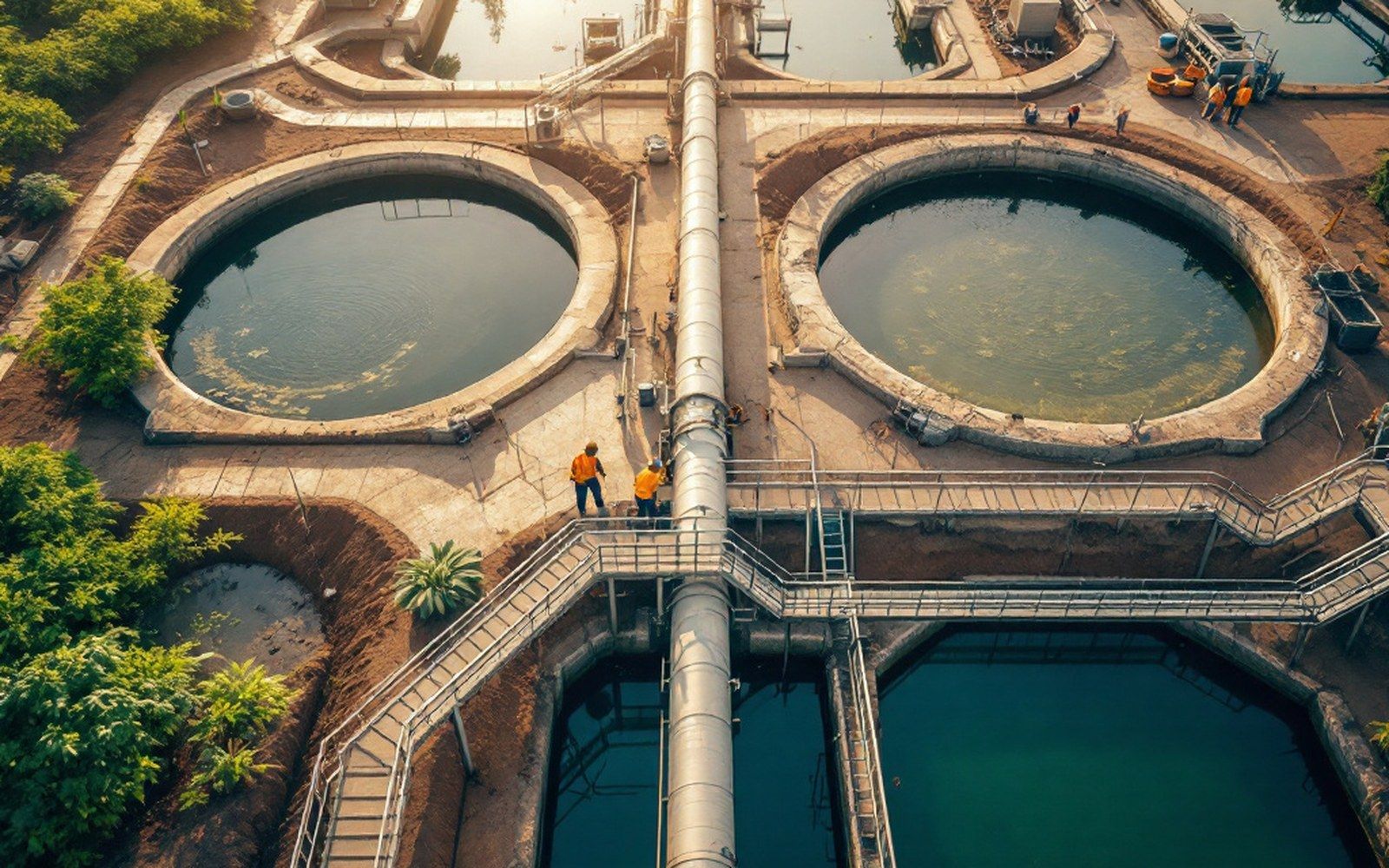
The same membrane, a different feed. Reuse runs at roughly a tenth of the pressure seawater demands.
The treatment is not the hard part
Treated wastewater can be returned to a drinking-water system. That sentence is technically uncontroversial — the engineering exists, has existed for decades, and the product meets or exceeds the standards set for conventional sources. The obstacle has almost always been something else: cost structure, regulatory classification, and the persistent human aversion to a product whose origin people know.
The process that makes reuse possible is a train of treatments, each removing what the previous stage left behind. Secondary-treated wastewater — the output of a conventional sewage plant — still contains dissolved organic compounds, trace pharmaceuticals, nitrates, and pathogens at concentrations that disqualify it from a drinking supply. What is added on top of that baseline is a sequence: membrane filtration to strip suspended solids, then reverse osmosis, which forces water under pressure through a membrane dense enough to reject dissolved salts and most organic molecules, then ultraviolet disinfection with hydrogen peroxide to destroy any residual compounds that passed the membrane. The product of that sequence, which engineers call advanced purified water, consistently meets or beats US Environmental Protection Agency drinking-water standards across hundreds of measured parameters.
Supply that scales with the population generating the feedwater, delivered through the network already in the ground.
The energy cost of that train is real and not trivial. Reverse osmosis across a reuse plant runs at roughly 0.3 to 1.0 kilowatt-hours per cubic metre, depending on feedwater quality and recovery rate — significantly less than seawater desalination, which operates against the full osmotic pressure of salt water and requires 3 to 10 kilowatt-hours per cubic metre. For an inland city with no coastal option, the arithmetic already favours reuse on energy alone, before factoring in the capital cost of intake pipes, marine outfalls, and brine disposal infrastructure that a desalination plant requires. The brine stream from a reuse plant is also less concentrated and more manageable, since municipal wastewater starts much less saline than the sea.
What the regulatory path looks like
The United States has no single federal standard for direct potable reuse — the practice of returning purified wastewater to a drinking-water distribution system without an intermediate environmental buffer. That regulatory gap means each state has built its own framework, at its own pace, with its own terminology. California, Texas, Colorado, and Arizona have all moved to establish or are in the process of establishing direct potable reuse rules. California, which operates the largest water reuse programme in the country, spent decades on indirect potable reuse: purified water was discharged to a groundwater basin or reservoir, mixed with the ambient water, and later extracted and treated again before distribution. The environmental buffer served partly as an additional treatment stage and partly as a perceptual one — it gave the water a different origin story.
The Orange County Water District in Southern California runs the most studied example of indirect potable reuse at scale. Its Groundwater Replenishment System, operational since 2008 and expanded since, produces up to 130 million gallons per day of advanced purified water and injects it into the Orange County Groundwater Basin, from which it is later pumped as drinking water. The project displaced an equivalent volume of imported Colorado River water, reducing both cost and dependence on a system where every claimant on paper already draws more than the river reliably delivers.
Texas, facing different geography and sharper supply constraints in its western reaches, moved further and faster on direct potable reuse. Big Spring, a city in west Texas, began operating a direct potable reuse facility in 2013 that feeds purified wastewater directly into the raw water supply for its conventional treatment plant. The approach is sometimes called reservoir augmentation or raw-water augmentation to distinguish it from feeding purified water straight into the distribution system, but the principle is the same. The Texas Commission on Environmental Quality has published technical guidance and permit pathways that give municipalities a defined regulatory route.
What resistance looks like and why it is durable
The documented aversion to recycled water for drinking — sometimes called the "yuck factor" in the engineering and social-science literature, though the underlying psychology is more precisely disgust sensitivity attached to contamination cues — does not track closely with actual risk. Surveys consistently show acceptance rates rising when respondents are given detailed, accurate information about the treatment process, the monitoring regime, and the comparison with conventional sources. But acceptance in a survey and acceptance at a public hearing are not the same thing. San Diego's water reuse programme was defeated by public opposition in the 1990s; the city eventually approved a different version decades later after sustained engagement.
What shifts public response most reliably, according to research published through the Water Research Foundation, is transparent communication over time: detailed disclosure of what is removed and what remains, independent monitoring with publicly accessible results, and avoiding defensive or promotional language. The projects that struggled most were those announced at scale before a relationship of trust existed. The projects that succeeded tended to start with groundwater replenishment — the environmental buffer reducing the directness of the connection — and expand incrementally.
The cost of a well-run advanced purified water train, including debt service on capital, typically falls between two and five dollars per thousand gallons of product water, varying with plant scale, labour market, and local energy costs. Conventional surface-water treatment in the US ranges from less than one dollar to over four dollars per thousand gallons depending on source quality and infrastructure age. The ranges overlap. Reuse is not uniformly cheap, but it is not categorically more expensive than alternatives — and unlike most alternatives, it scales with the population that generates the feedwater, meaning supply and demand grow together.
The projects that struggled most were those announced at scale before a relationship of trust existed.
Singapore's national water agency, PUB, runs the most internationally visible potable reuse system under the name NEWater. Since 2003, NEWater has supplied an increasing fraction of the city-state's total water demand, with product water meeting requirements for both industrial use and, blended into reservoirs, eventual drinking supply. PUB publishes detailed water quality data and has made plant visits part of public outreach. Singapore's unusual position — a dense, water-scarce city-state with no significant groundwater and constrained catchment — made reuse a policy priority rather than a political option, and the programme has operated without the public rejection that delayed adoption elsewhere.
The engineering settled long before the policy and the public conversation did. That gap is where the water went.