Desalination and the brine that comes with it
Turn seawater into drinking water and you also manufacture a waste stream twice as salty as the sea.
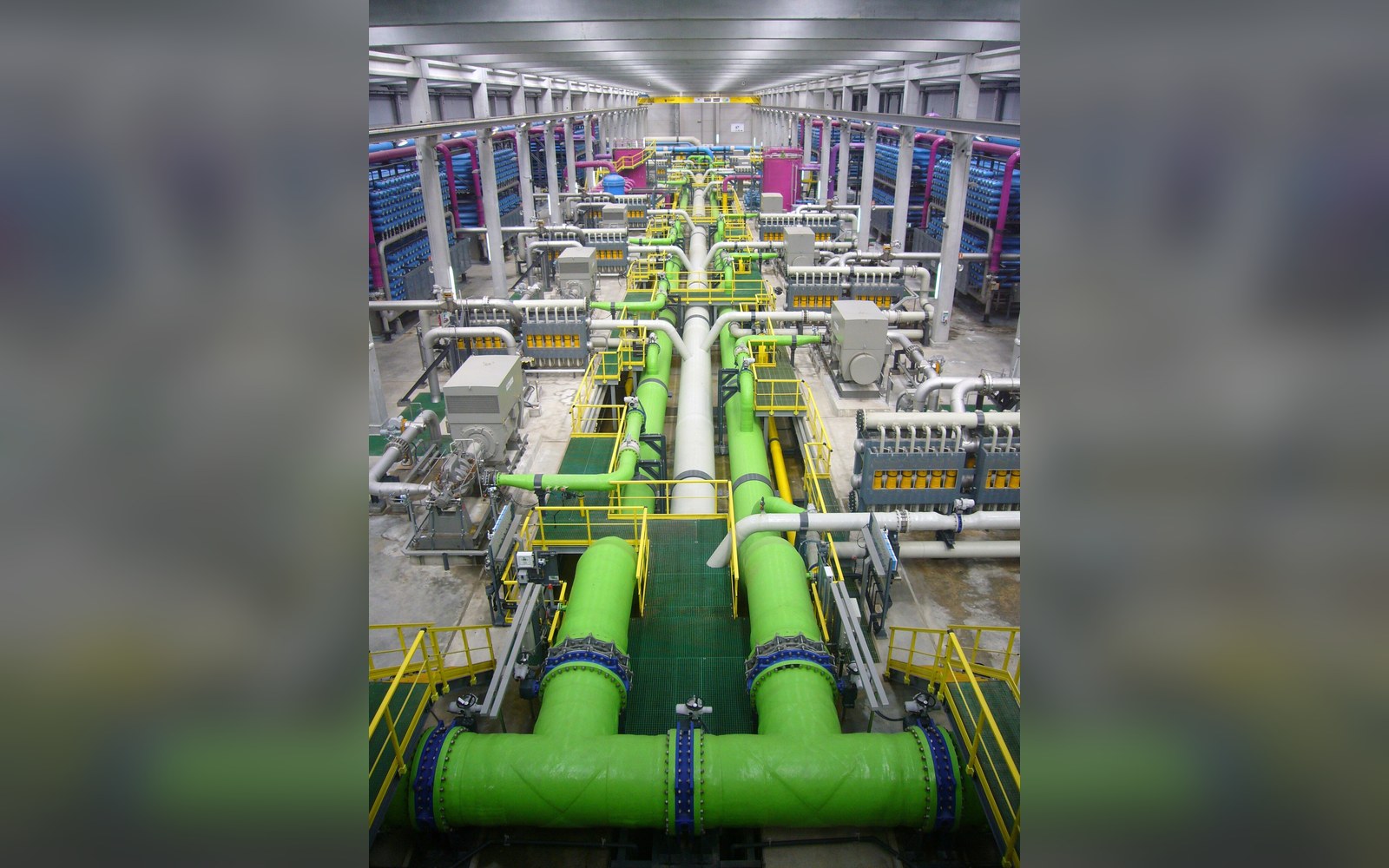
Energy recovery between the trains has cut specific consumption roughly in half since the early 2000s. The concentrate still leaves at twice the salinity of the feed.
Photo · Wikimedia CommonsHow reverse osmosis works, and what it costs
Seawater is roughly 35,000 parts per million dissolved solids. Drinking-water standards in most jurisdictions sit below 500 ppm. Closing that gap by more than ninety-eight percent requires either boiling the water and collecting the steam — the thermal distillation that dominated early Gulf-state plants — or forcing it through a membrane whose pores are fine enough to block salt ions. The second method is reverse osmosis, and it now accounts for the majority of global desalination capacity.
The physics is straightforward. Osmotic pressure naturally drives water through a semi-permeable membrane toward the saltier side; reverse osmosis applies mechanical pressure to push it the other way. At seawater concentrations, overcoming that osmotic pressure requires roughly 27 bar before any engineering losses are added. Real plants operate at 55–70 bar once friction, membrane resistance, and concentration polarisation — the thickening of the salt layer immediately adjacent to the membrane surface — are accounted for. Energy consumption at a well-run modern plant runs between 3 and 4 kilowatt-hours per cubic metre of product water. That figure sounds modest until it is multiplied across the output of a large facility: the Sorek B plant under construction near Tel Aviv, which will be among the world's largest when complete, is designed for around 200 million cubic metres per year, implying an electricity demand comparable to a mid-sized city's entire consumption.
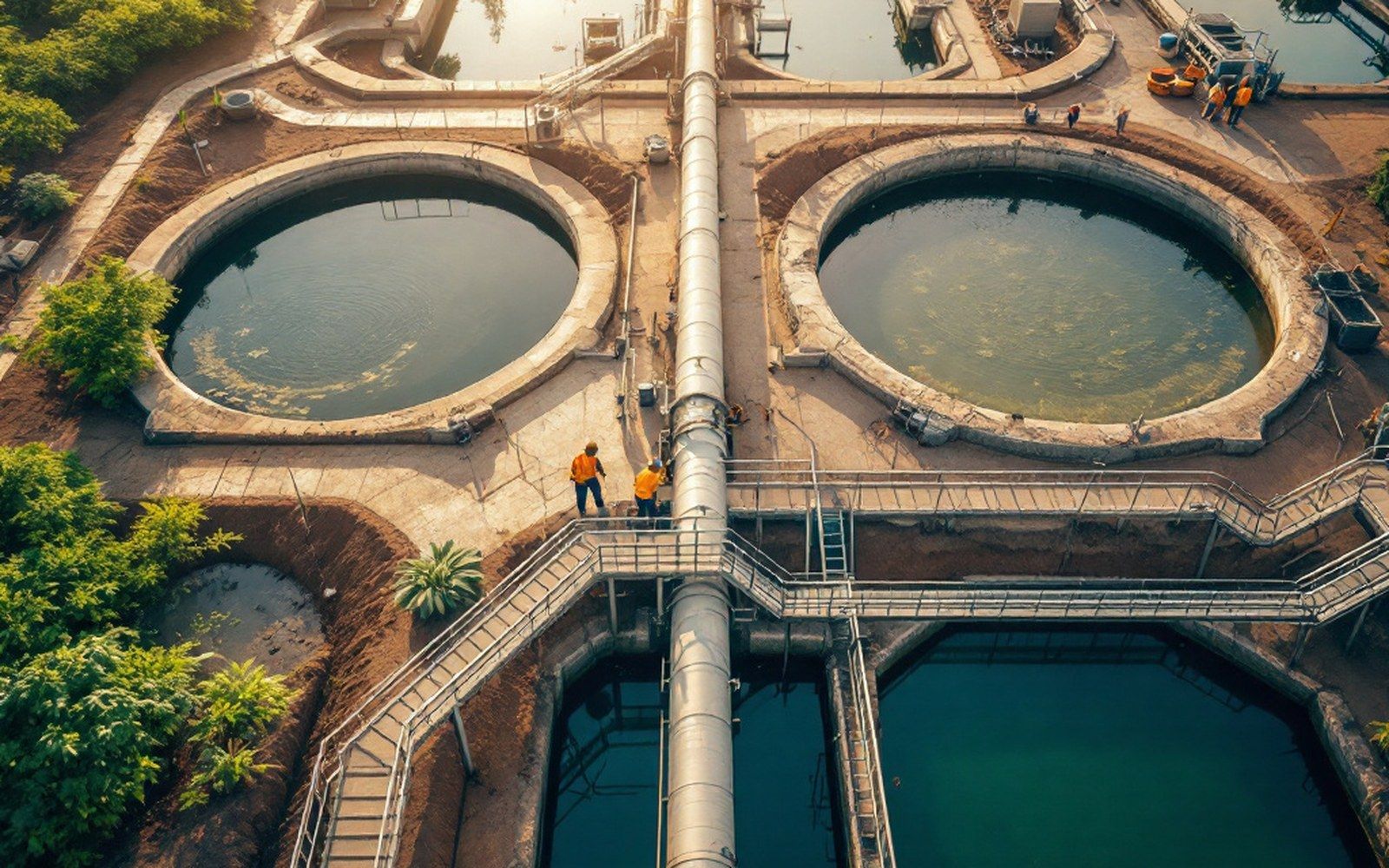
Inland, the same membranes run against a far weaker feed, and the brine is more manageable for it.
Energy recovery devices — turbines or isobaric chambers that capture pressure from the outgoing concentrate stream — have cut specific energy consumption roughly in half since the early 2000s. Capital costs for a full seawater reverse osmosis facility, including intake, pre-treatment, the membrane trains, post-treatment to restore hardness and pH, and disposal infrastructure, typically fall between $1,000 and $2,500 per cubic metre of daily capacity, depending heavily on local construction costs, energy prices, and what the brine disposal actually requires. That last variable is often underestimated in early project budgets.
The concentrate stream: where the salt goes
For every litre of product water a reverse osmosis plant delivers, it returns somewhere between 1.2 and 2 litres of concentrate — water that carries all the salt removed from both volumes, plus any anti-scalant chemicals added during pre-treatment. At a typical recovery rate of around 45 percent, the concentrate leaving a seawater plant is roughly twice the salinity of the feed: around 70,000 ppm. According to a 2019 study published in Science of the Total Environment and widely cited by the United Nations Environment Programme, global desalination plants were already producing an estimated 142 million cubic metres of concentrate every day — significantly more than the volume of product water generated.
For coastal plants the obvious disposal route is the ocean, and most large seawater facilities use it. That is not without consequence. A dense, warm, chemically altered plume discharged near the seabed can suppress dissolved oxygen, raise local salinity well above ambient, and concentrate heavy metals scoured from infrastructure. The severity depends on discharge design: diffuser arrays that promote rapid mixing can reduce the salinity anomaly at the edge of a mixing zone to near-background levels within tens of metres, and most modern coastal permits require diffusers for that reason. The United States Geological Survey's work on brine chemistry documents the range of co-contaminants present in concentrate from different source waters, an issue that grows more complicated for plants drawing on already-brackish estuaries.
Inland plants face a harder problem. There is no ocean nearby, and the concentrate options narrow to deep-well injection, evaporation ponds, or — at very high cost — zero-liquid-discharge processes that crystallise the salt into solid waste. Deep-well injection is the cheapest of these, running perhaps $0.30–$0.50 per cubic metre of concentrate disposed, but it requires suitable geology: a porous receiving formation, an impermeable cap rock, and confidence that the injected brine will not migrate toward fresh groundwater. Evaporation ponds work where land is cheap and the climate is dry, but they consume large areas — a 10 million cubic metre per year plant might need hundreds of hectares of lined pond surface — and the residual salt still has to be disposed of eventually. Zero-liquid-discharge systems, which combine thermal evaporators and crystallisers to produce solid salt cake, currently add $1–$3 per cubic metre to treatment costs, occasionally more, and the energy penalty is substantial enough that the technology remains uncommon outside regulatory environments that effectively prohibit liquid discharge.
Scale, siting, and the limits of the engineering answer
Desalination's global installed capacity has grown substantially over recent decades. The International Desalination Association's data, summarised by the World Resources Institute, showed capacity exceeding 100 million cubic metres per day by the early 2020s, concentrated heavily in the Arabian Peninsula, the Mediterranean, and Australia. Saudi Arabia, the UAE, and Israel together account for a large share of that total.

The constraint that limits desalination as an answer to inland water stress is one of basic geography. It cannot help the High Plains directly: the Ogallala Aquifer underlies land that is hundreds of miles from any coast, and the energy and pipeline infrastructure required to move desalinated water inland at agricultural volumes would cost more than the water is worth at commodity crop prices. What desalination can do is free up surface water elsewhere in a coastal state's allocation, leaving more for inland transfer — the logic behind proposals to desalinate along the California coast and reduce pressure on the Colorado River system. The Bureau of Reclamation has studied this concept in detail; the arithmetic is not impossible, but a plant large enough to matter at the scale of Lake Mead's bathtub ring would rank among the largest engineering projects in American history.
The membrane itself degrades. Biofouling — microbial growth on the membrane surface — and scaling from calcium carbonate and other minerals require chemical cleaning cycles, and membranes must be replaced on cycles of five to ten years, a recurring capital cost that does not appear in headline figures. Pre-treatment to reduce fouling can account for a quarter of a plant's total energy draw. These are solved engineering problems, in the sense that there are standard approaches for all of them, but each one adds to the cost floor that makes desalination water considerably more expensive than any existing fresh source. The engineering works; the economics set the limits.