Drip irrigation's real arithmetic
More efficient at the field, higher-consuming at the basin: why saving water does not always save water.

Under flood and pivot, a fifth to over half of what is applied returns to the aquifer or the drain. Drip removes that fraction.
The field level and the basin level are not the same accounting unit
A drip system delivers water directly to the root zone, bypassing the evaporation and runoff losses of flood or centre-pivot irrigation. Measured at the field, the numbers are hard to argue with: a well-managed drip installation typically applies ten to fifty percent less water per hectare than surface flooding to achieve the same yield. That is the figure that appears in project proposals, subsidy programmes, and equipment brochures. It is also the wrong figure to use when assessing what happens to a river, an aquifer, or a basin-wide water budget.
The reason is return flow. Under flood irrigation, a significant fraction of the water applied — anywhere from twenty to over half, depending on soil type, slope and management — does not stay in the plant or evaporate. It runs off into drains or percolates down through the soil profile, eventually reaching groundwater or rejoining a stream downstream. Farmers further down the canal or further along the aquifer have always depended on it, sometimes without knowing it. That return flow is inefficiency in one accountant's ledger and a water source in another's.
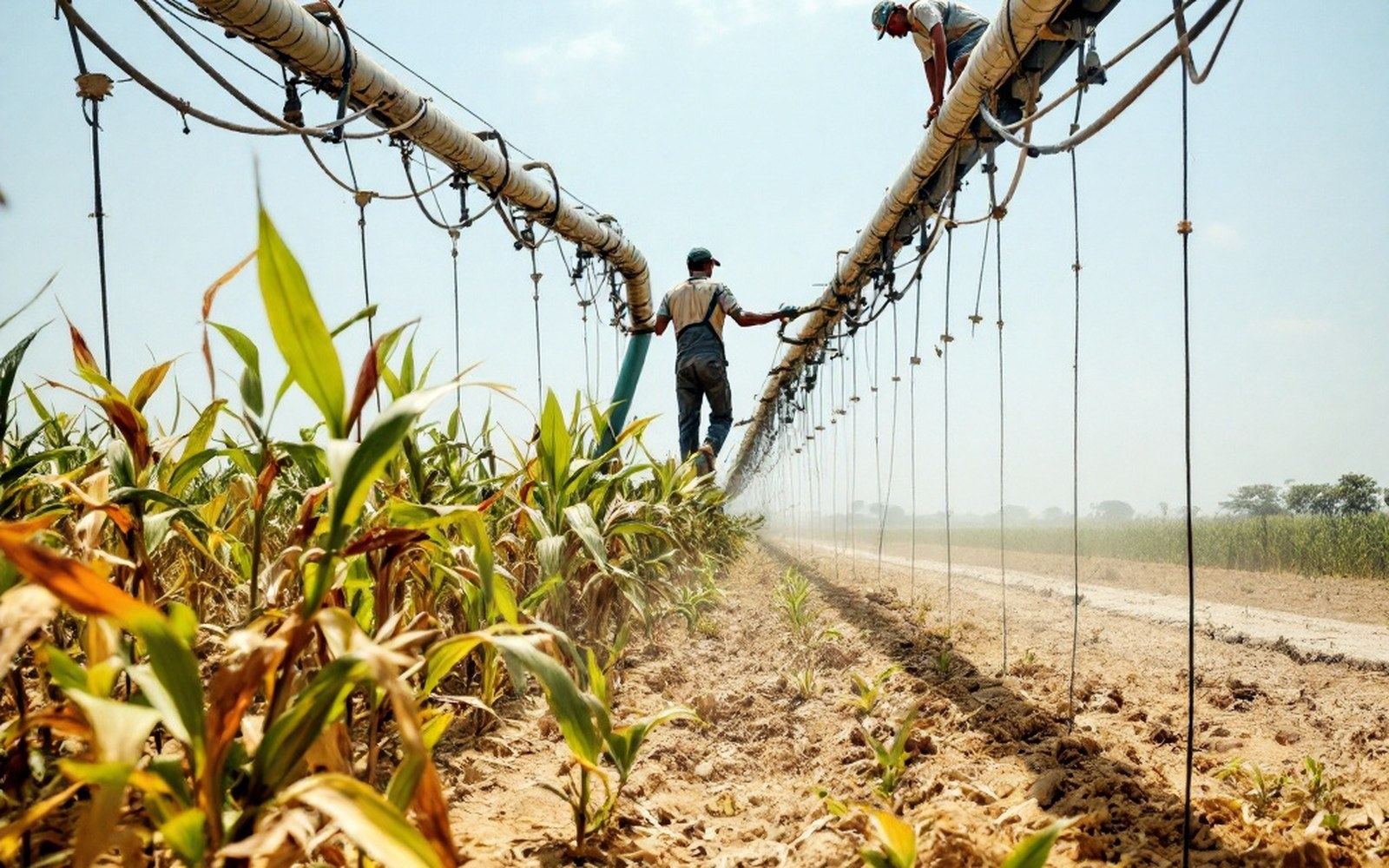
Efficiency lowers the marginal cost of irrigating one more hectare, which is why applied volume falls and consumption does not.
Drip irrigation eliminates most of that fraction. Applied volumes fall, consumptive use — the share genuinely extracted by the plant and lost to the atmosphere — holds steady or rises, and return flow collapses. The result, familiar to hydrologists but persistently absent from policy conversations, is that total depletion of the basin's water stock can increase even as field efficiency climbs. The United States Geological Survey has documented versions of this pattern across irrigated regions of the American West, where efficiency improvements preceded continued aquifer drawdown rather than checking it.
What the arithmetic actually shows
The mechanism has a name in the literature: the efficiency paradox, or more formally, the rebound effect applied to irrigation water. It operates through two channels simultaneously. First, reduced return flow means less water cycling back to aquifers and streams. Second, higher efficiency tends to lower the marginal cost of irrigating an additional hectare, so farmers commonly expand irrigated area, increase crop intensity, or switch to higher-value, thirstier crops — all rational responses to the economics, all of which push consumptive use upward.
Research drawing on satellite data from NASA's Jet Propulsion Laboratory and the GRACE gravity mission has made basin-scale depletion visible in ways that field-level measurement cannot. GRACE detected groundwater mass loss across the Ogallala Aquifer throughout the 2000s and 2010s, a period that saw substantial investment in drip and sub-surface drip technology across Kansas and the Texas Panhandle. The Kansas Geological Survey's monitoring network recorded continued saturated thickness declines in the same counties where drip adoption was heaviest, though attributing that decline to any single variable requires care — commodity prices, crop choice, and precipitation all move simultaneously.
The Imperial Valley, California, provides a concrete illustration of a related transfer: when the Imperial Irrigation District improved conveyance efficiency in the early 2000s as part of a Colorado River water transfer agreement, the conserved water was real — but it came partly at the expense of the Salton Sea, which had been sustained by agricultural drainage. Reduced return flow translated directly into a shrinking lake.
Engineering drip to close the loop
None of this means drip irrigation is the wrong technology. It means the accounting must be done at the correct scale. Where a basin is already fully allocated and return flows are genuinely captured by downstream users — legally recognised under prior appropriation doctrine or physically measured in monitoring networks — switching to drip without retiring irrigated acreage does not reduce basin depletion. Where land is retired in proportion to the efficiency gain, the arithmetic can close. Several Ogallala-overlying districts have piloted fallowing programmes alongside efficiency improvements for exactly this reason.
Several Ogallala-overlying districts have piloted fallowing programmes alongside efficiency improvements for exactly this reason.
The World Resources Institute's Aqueduct platform and similar basin-level accounting tools now distinguish consumptive use from withdrawal explicitly — a distinction that field-efficiency metrics have long obscured. Drip technology, priced correctly and deployed with acreage constraints attached, can reduce depletion. Deployed alone, it can easily increase it. The engineering works; the accounting is where the water goes.